Thursday 25th February at 6pm
Fred Gray
Designing Brighton’s Seafront: The Genuis of Lockwood and Edwards
This talk tells the story of the reinvention of Brighton’s seafront by two hugely influential Brighton public servants: Philip Lockwood and David Edwards.
Working during the eight decades to the outbreak of the Second World War, Lockwood (1821-1908) was borough surveyor and Edwards (1877-1947) surveyor and engineer for the resort. Creating much of the seafront we know today, their genius included grand designs and the minutia of seaside railings and shelters.
Lockwood ornamentalized and orientalized the older part of the seafront. Think the birdcage bandstand close to the old boundary with Hove and, clothing Kemptown’s naked chalk cliffs, the magnificent Maderia Terrace.
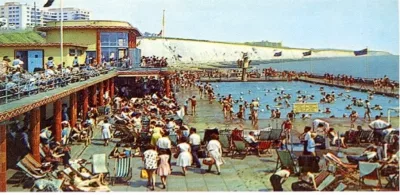
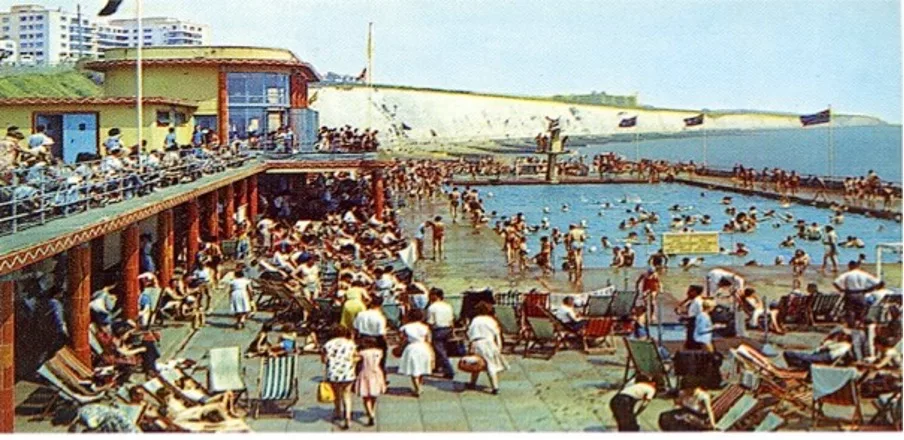
Then, between the two wars of the next century, Edwards made modern the new long seafront with iconic projects including Black Rock bathing pool and the undercliff walk to Saltdean.
Fred Gray was the West Pier honorary historian for several decades. He has long been fascinated by the seaside in Britain and elsewhere.
Thursday 18th March at 6pm
David Fisher
The Birth (and Death) of Colour Cinematography in Brighton
Colour film is something we take for granted but the story of its origins in the first years when cinematography itself was still new goes from invention to achievement to success to rivalry, lawsuits and ultimate failure. It began in Brighton & Hove, developed in Southwick and was eventually poised to conquer the world. Then a challenge from another adopted Brightonian led to its collapse and failure.
David Fisher’s lavishly illustrated talk follows the intriguing local story from beginning to an end that meant we now think Technicolor rather than Kinemacolor.
David Fisher is the author of Cinema-by-Sea: Film and cinema in Brighton & Hove since 1896 and is the current chair of the Regency Society
Image: The Kinemacolor studio in Cambridge Grove [RS James Gray Collection]
Thursday 22nd April at 6pm
Frank Gray
Immersive Victorians & the Beginnings of Stereoscopy
A particular characteristic of Victorian culture was an interest in new and absorbing immersive experiences where the viewer could step into the ‘other’ and become separated from the everyday world. This immersion within either real or artificial environments was enabled in the 19th Century by the building of piers, art galleries, aquariums, theatres, exhibition halls and music halls. Brighton emerged as an important centre for these new ‘spaces’. Allied to this immersiveness, was a new vision technology that introduced an ‘inner’ immersive space that would take over the viewer’s field-of-view. This was the stereoscope. Developed and promoted by Sir David Brewster and catalysed by the arrival of photography, stereoscopes and stereoscopic ‘views’ on card of places, people, art and the supernatural became easily available by the late 1850s. A number of Brighton commercial photographers joined this new field, especially W. H. Mason Jr. of 108 King’s Road. His coloured stereoscopic cards of familiar places, still lives and genre scenes became very popular and attracted national attention. This talk provides an opportunity to reflect on immersive experiences and enter into stereoviews of Brighton.
Dr Frank Gray is an early media historian, a curator of film exhibitions for Brighton & Hove Museums, the co-founder of Cinecity (the Brighton Film Festival) and the retired Director of Screen Archive South East at the University of Brighton. The archive collects, preserves and shares films made in Brighton & Hove and the region.
Thursday 27th May at 6pm
Sammie Aplin
Trash or treasure? Turning Brighton’s Beach Litter into Artwork
Join Sammie for a talk exploring beach cleaning in Brighton and around the world. Discover how plastic collected from our beaches is used to create personalised, commissioned artwork. The talk will discuss nostalgia, the environment, wellbeing and community.
Thursday 24th June at 6pm
Geoffrey Mead
The Far East of Sussex: Aspects of Rye Bay
The physical landscape of Rye Bay stretches from the sandstone cliffs of Fairlight Head, across the reedbeds of Pett Level, the vast shingle banks of Rye Harbour, to the high sand dunes of Camber. The human landscape takes in plotlands at Winchelsea Beach, the Cinque Ports ‘Antient Towns’ [sic] of Winchelsea and Rye, the industry of Rye Harbour and the Coastguard Cottages at Jury’s Gap. This talk looks at a range of aspects of this complex landscape.
I was born and raised in Brighton, as was my dad. I attended Brighton, Hove & Sussex Grammar School…but did not thrive! Eventually took a BA in Geography, an MA in Local & Regional History and my PhD in Brighton’s interwar suburbs-‘Scattered squalor-Downland Homes’, all at the University of Sussex.
I was a West Pier guide from 1997-2002 and did the penultimate tour!
Thursday 22nd July at 6pm
Jackie Marsh-Hobbs
Brighton Station Tours
Brighton Station, a Grade II* listed building, with its ornate cast iron and impressive five acre glass roof, is a testimony to Victorian engineers and builders. It was almost lost in the 1970s when British Rail wanted to demolish it and replace it with a modern station and hotel. In the late 1990s Brighton Station had a £28 million refurbishment, which was when the cast iron was painted dark blue. In 2001 the Brighton Station tours started as part of Brighton Festival in May. These tours were initiated, researched and conducted by Jackie, and she continued to lead them, as part of the Festival, until 2025. In 2024/5 she took part in a heritage project exploring the hidden underground spaces and Victorian history beneath Brighton Station.
Jackie Marsh-Hobbs is a local historian, lecturer and tour guide.
Thursday 19th August at 6pm
David Rudling
Roman Seaside Villas in Sussex
This talk will review the results of recent archaeological research regarding some of the Roman-period coastal villas in Sussex. Some of these villas, such as those at Eastbourne and at Southwick, were discovered and first investigated many years ago. Other sites, such as at Fishbourne and at Newhaven, are more recent discoveries. The talk will consider some of the contributions made by recent investigations to the study of villa development in Sussex, and the process of ‘romanisation’ more generally.
Dr DAVID RUDLING FSA
David is the Academic Director of the Sussex Archaeology and History. Previously David worked for 25 years for the UCL Field Archaeology Unit, before switching to the University of Sussex where he was Senior Lecturer in Archaeology. David’s research interests include Roman-period rural settlements, land-use, religion and ritual in Britain, and ancient and medieval coins. He is a Fellow of the Society of Antiquaries of London, a Member of the Chartered Institute for Archaeologists, and Chairman of the Council for British Archaeology South-East.
Thursday September 23rd at 6pm
Annebella Pollen, Sally Jones and Sylvie Jane Lewis
William Constable [1783-1861]: Brighton’s Pioneering Portrait Photographer
When photography was brand new, and as soon as it became possible for studios to operate under license, the artist, engineer and surveyor William Constable brought the latest portrait technique to Brighton. His studio, established 1841 at 57 Marine Parade, was the first in town, and one of the first outside London. It caused a sensation. Nobility and royalty flocked to have their likenesses taken with unprecedented accuracy, but also with imagination and humour. Despite his major contributions to photography, Constable’s name is little known. The largest group of his surviving daguerreotype photographs, in the National Museum of American History, Smithsonian Institute, Washington DC, remained mostly unpublished and unresearched until a 2026 University of Brighton project brought its stories to light. This talk, by the Brighton researchers who undertook the research, introduces Constable and showcases his collection.
Annebella Pollen is Professor of Visual and Material Culture at University of Brighton and the West Pier Trust’s Honorary Historian and Archivist. She led the 2026 Constable research project with Shannon Perich, Curator of the Photographic History Collection at National Museum of American History. Sally Jones and Sylvie Jane Lewis, University of Brighton Postgraduate Researchers, worked on the Constable project as placement PhD students.
Thursday 28th October at 6pm
Trevor Beattie
A Tour of Brighton and its Piers by Magic Lantern
Travel back in time to enjoy a Magic Lantern tour of Brighton and its piers
Join Trevor Beattie, magic lanternist, for a unique show of original lantern slides of Brighton and Hove in the nineteenth century, including the West Pier, Chain Pier, Palace Pier and Daddy Long legs. Trevor will use a Victorian magic lantern from the 1890s to project the early photographs and will also show some of the coloured hand painted, animated slides that presented moving pictures before the cinema.
Trevor Beattie is a member of the Magic Lantern Societies of both the UK and US – see www.trevorblanternist.co.uk He gives magic lantern shows across the south east, including an annual Christmas show in Hove, and specialises in slides of Brighton and Hove. He recently retired as Chief Executive of the South Downs National Park Authority.
Thursday 18th November
Annebella Pollen
Blackface in Brighton
For well over a hundred years, from the 1830s to the 1960s, troupes of minstrel musicians, mostly comprised of white-skinned performers with artificially blackened faces, were a popular form of entertainment in Britain. This talk examines the rise and fall of Blackface minstrelsy, its place at the British seaside, and its appearance on Brighton’s streets, stages, beach and piers. It discusses its early nineteenth-century North American origins and its twentieth-century British persistence as a form of racial mockery in increasingly multicultural spaces and times.
Content warning: This lecture will include historic examples of racist imagery and language.
Annebella Pollen is Professor of Visual and Material Culture at University of Brighton, a trustee of the West Pier Trust and its Honorary Historian and Archivist. She has previously given talks at the West Pier Centre on insulting Victorian valentines, saucy Edwardian postcard messages, British nudism, the radical history of socks and sandals, and the history of seaside silhouettes.
Please visit West Pier Trust on EventBrite for full details and to book.